

In New York No-Fault, reimbursement is not supposed to be a creative exercise. The law is remarkably clear: benefits must be paid in accordance with the established fee schedule, and for durable medical equipment (DME), that means strict adherence to the New York State Workers’ Compensation Fee Schedule, which itself aligns heavily with Medicaid-based reimbursement methodologies.
Under New York Insurance Regulation 83 and related Workers’ Compensation provisions, providers seeking reimbursement for DME must substantiate their charges with legitimate documentation. When an item is not explicitly listed in the fee schedule, reimbursement is generally calculated based on acquisition cost plus a regulated markup of 50%, or the product’s usual and customary public price – whichever is less. In simpler terms: if you are billing for an unlisted item, providers must submit legitimate proof of acquisition cost in the form of warehouse or supplier invoices.
Not a guess.
Not a suspicious spreadsheet.
Not an invoice that looks like it was assembled during a lunch break in Microsoft Excel 2007.
Our team routinely reviews DME submissions where the supporting invoices appear less like authentic wholesale purchasing records and more like something hastily assembled in a spreadsheet moments before submission.
Missing tax IDs, vague product descriptions, suspiciously rounded pricing, inflated shipping costs, residential addresses, and formatting so minimal it would make legitimate distributors blush—these are not rare occurrences. In fact, questionable invoices are one of the more common patterns we encounter during fee audits and SIU support reviews.
Case Study: The $300 Miracle
One particularly memorable case involved a prescription and doctor’s order for what was essentially an infrared heating pad. Straightforward enough. However, the supporting invoice told a much grander story, listing high-end therapeutic devices with pricing that immediately raised eyebrows.
Without violating privacy concerns, allow us to share an example taken from an actual submitted invoice to go through together as an exercise:
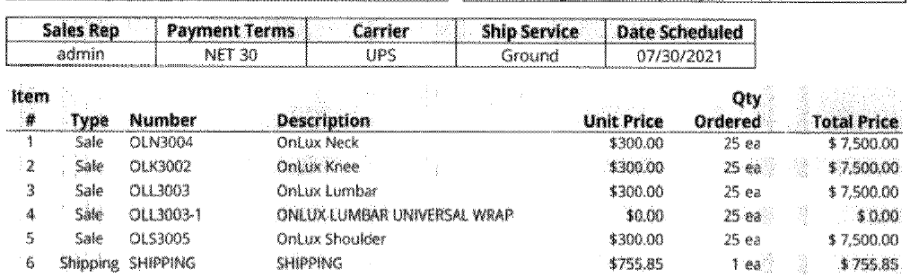
The invoice includes multiple OnLux products, including neck, knee, lumbar, and shoulder devices. Each device, regardless of type, was listed at exactly $300.00 per unit.
Now, anyone who has purchased… well, almost anything… knows that perfectly rounded pricing across multiple specialized medical devices is about as common as finding a unicorn in prior authorization. Medical-grade devices, particularly FDA-registered photo biomodulation products, do not typically arrive in neatly packaged, identical price points unless someone is making reimbursement math unusually convenient.
Practice Exercise: What’s Wrong in the picture
The formatting lacked many of the hallmarks expected of legitimate wholesale or medical supply invoices:
- Minimal professional formatting despite a transaction value approaching $30,000
- Identical pricing for multiple distinct devices
- Lack of detailed product specifications
- No serial or model numbers
- No tax line items
- No authentic branding markers
- No robust supplier identifiers
In other words, for such a significant commercial purchase of $30,000, the invoice looked surprisingly… underwhelming.
And then came the shipping:
UPS Ground: $755.85
For lightweight therapy devices. It is unlikely that 125 of them would rack up such a high domestic UPS Ground shipping cost.
To put this into perspective, shipping costs in that range are more commonly associated with freight shipments involving pallets, bulk cargo, or oversized commercial transport—not wearable infrared devices.
>>> For example, $755 is a starting shipping price for freight shipping between Fresno, CA and Corvallis, OR. For novices here, freight shipping is the transportation of goods, commodities, and cargo in bulk via road, rail, sea, or air, typically involving items too large or heavy for standard parcel carriers (over 150 lbs), typically stacked on pallets or inside containers, not for small couriers like UPS Ground.

Unless these heating pads were individually gift-wrapped in lead-lined titanium containers, or they were shipped inside reinforced gold-plated crates, something felt… inflated.
But the invoice concerns did not end there.
Market Reality Check
The OnLux devices referenced are legitimate products with significantly higher retail and government market pricing. Publicly available data showed these devices priced at over $2,300 each through legitimate channels such as GSA Advantage and authorized distributors. If the invoice submitted is to be believed, these devices were somehow obtained at an approximately 87% discount.
Possible? Perhaps.
Plausible without robust documentation, manufacturer agreements, liquidation records, or credible supplier context? That becomes much harder to accept.
And when discounts of that magnitude appear without clear manufacturer agreements, liquidation context, or supporting documentation, it raises legitimate SIU concerns.
It also raises an interesting question: how does OnLux feel about seeing its products appear on invoices that look this unprofessional and suspiciously discounted? For a company that invests in legitimate product development, FDA registration, and established distribution channels, being associated with poorly drafted invoices, missing details, and pricing that appears dramatically below market value could create real concerns.
At best, it suggests unauthorized or questionable sourcing. At worst, it risks damaging the credibility of the brand itself. There is a major difference between legitimate wholesale discounts and invoices that look more like improvised reimbursement tools than authentic commercial purchasing records.
And unfortunately, this was not an isolated case.
Case Study 2: Another Invoice, Same Plotline
In another reviewed submission, our team encountered an invoice featuring nearly 600 products, including fragile lamps, with shipping billed at only $80.00 and tax conveniently listed at 0.00%.
Product descriptions ranged from generic to nearly useless, including one item identified simply as “whirlpool.” In DME terms, “whirlpool” could refer to anything from sophisticated tub-sized hydrotherapy equipment to a small consumer-grade attachment. Yet no model, manufacturer, or meaningful detail was provided.
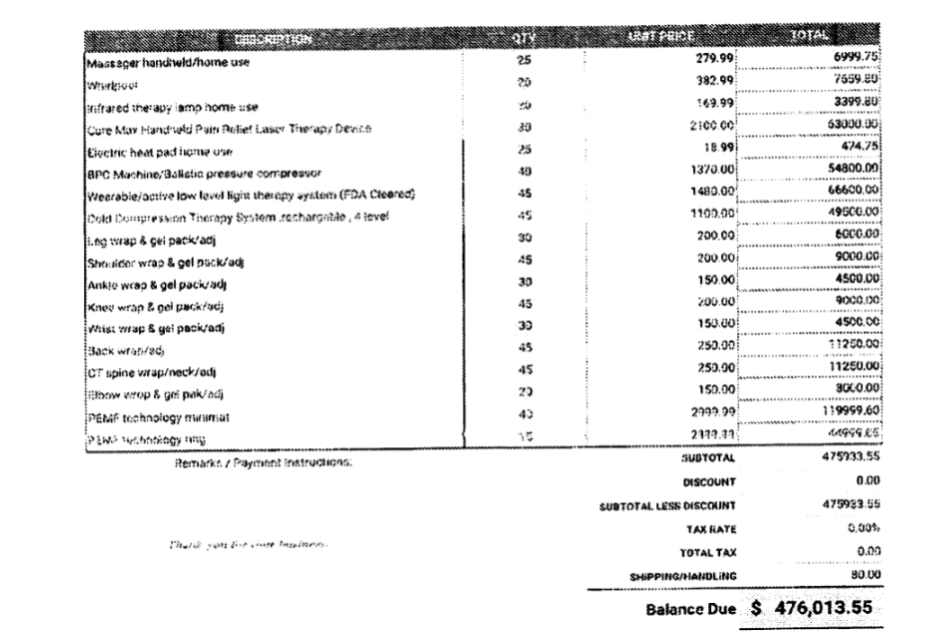
Practice Exercise 2: What’s wrong in the picture
- 595 items shipped
- Fragile lamps included
- Sales tax: 0.00%
- Shipping: $80.00
- Product descriptions: vague
- Numbers – typed without formatting
- One item simply called “whirlpool”
Just “whirlpool.”
No model.
No specifications.
Again, we saw the same recurring issues: Minimal specificity. Questionable formatting. Missing authenticity markers. Dubious financial presentation.
At this point, invoice review often begins to resemble forensic accounting with a side of consumer fraud investigation.
Our team has also encountered cases involving medication invoices dated years prior to the actual claim date of service, raising obvious concerns regarding expiration, inventory validity, and document authenticity. On multiple occasions, address verification for listed suppliers has led, not to warehouses or commercial distributors, but to private residences or even spa salons. In at least one case, the supplier address appeared to correspond with an active Zillow real estate selling listing.
Because apparently, some DME suppliers may operate between open houses.
Humor aside, these patterns matter.
New York No-Fault reimbursement depends heavily on proper documentation, and unsupported or suspicious invoices may suggest:
- Inflated acquisition costs
- Unsupported reimbursement demands
- Phantom inventory sourcing
- Potential fraudulent billing
- Regulatory noncompliance
- Broader SIU investigative concerns
For carriers, adjusters, legal teams, and SIU departments, invoice review should never be viewed as a simple administrative step. It is often one of the clearest windows into billing integrity—or lack thereof.
At AJHC, our team regularly dissects these submissions not just to determine proper reimbursement but to identify larger patterns of abuse, manipulation, and potentially fraudulent activity that may otherwise go unnoticed.
Because in many DME cases, the true red flags are not hidden in the prescription.
They are hiding in the invoice.
And sometimes, those invoices tell a story far more revealing than the medical records themselves.
The Bottom Line
If a basic heating pad somehow transforms into a premium therapeutic device package with suspicious discounts, vague sourcing, inflated shipping, and supplier addresses that look more residential than regulatory, someone should probably ask questions.
Our team does.
Every day.
And based on what we continue to find, we suspect we are only scratching the surface.
Need Help Dissecting Suspicious DME Billing?
Our team specializes in:
- DME invoice validation
- Fee schedule analysis
- Acquisition cost review
- SIU support
- Fraud pattern identification
- No-Fault reimbursement audits
Because sometimes the biggest red flag isn’t the device.
It’s the paperwork pretending to justify it.